Aerosol Spray Paint
Aerosol spray paint was new to hardware store shelves in the early 1950s, and Hedda Sterne quickly found it to be an ideal medium for expressing a sense of speed, light, and motion in her paintings of the decade. She would often combine spray enamel and acrylic paints with oil and oil sticks on canvas to achieve deeply layered effects.
Hedda Sterne, Third Avenue El, 1952-53, Oil and spray enamel on canvas, 40 3/8 x 31 7/8 in., Collection of The Metropolitan Museum of Art, New York, Gift of Mr. and Mrs. Daniel H. Silberberg, 1964 (64.123.4)
Hedda Sterne, New York VIII, 1954, Synthetic polymer paint on canvas, 6' 1/8" x 42", Collection of The Museum of Modern Art, New York, Mr. and Mrs. Roy R. Neuberger Fund, 558.1954
Hedda Sterne, New York, 1956, Oil on canvas, 32 1/8 x 50 1/8 in., Collection of The Art Institute of Chicago; Gift of Society for Contemporary American Art, 1956.62
Hedda Sterne, New York, N.Y., 1955, 1955, Airbrush and enamel on canvas, 36 1/4 × 60 1/4 in., Whitney Museum of American Art, New York; Gift of an anonymous donor, 56.20
Hedda Sterne, Road No. 6, 1956, Oil, spray paint on canvas, 86 1/8 x 50 1/8 in., Collection of The Pennsylvania Academy of the Fine Arts
Hedda Sterne, No. 3—1957, 1957, Oil, spray paint on canvas, 86 1/8 × 50 1/4 in., Collection of the Virginia Museum of Fine Arts, Richmond
Hedda Sterne, N.Y. 1 (Road #4), 1956, Oil, spray paint on canvas, 86 x 50 in.; Collection of the Krannert Art Museum and Kinkead Pavilion, University of Illinois at Urbana-Champaign; Gift of the artist, 2006-3-1
Hedda Sterne, Combine Platform, 1961, Oil, spray paint, and oil stick on canvas, 34 in. x 26 in., Collection of Deere & Co., Moline, IL; image courtesy Deere & Co.
Hedda Sterne, Six Cylinder Engine, 1961, Oil, spray paint, and oil stick on canvas, 34 in. x 26 in., Collection of Deere & Co., Moline, IL; image courtesy Deere & Co.
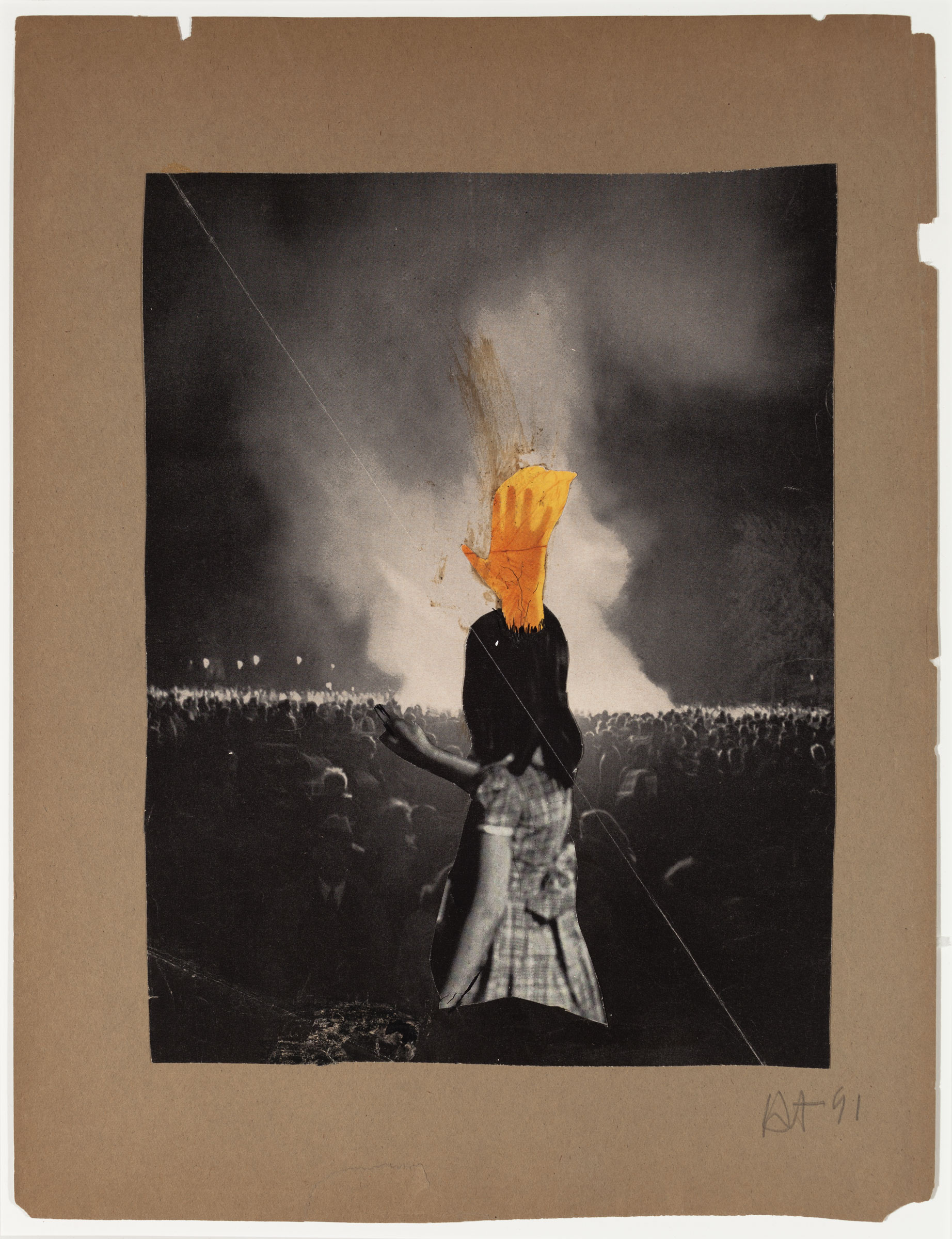
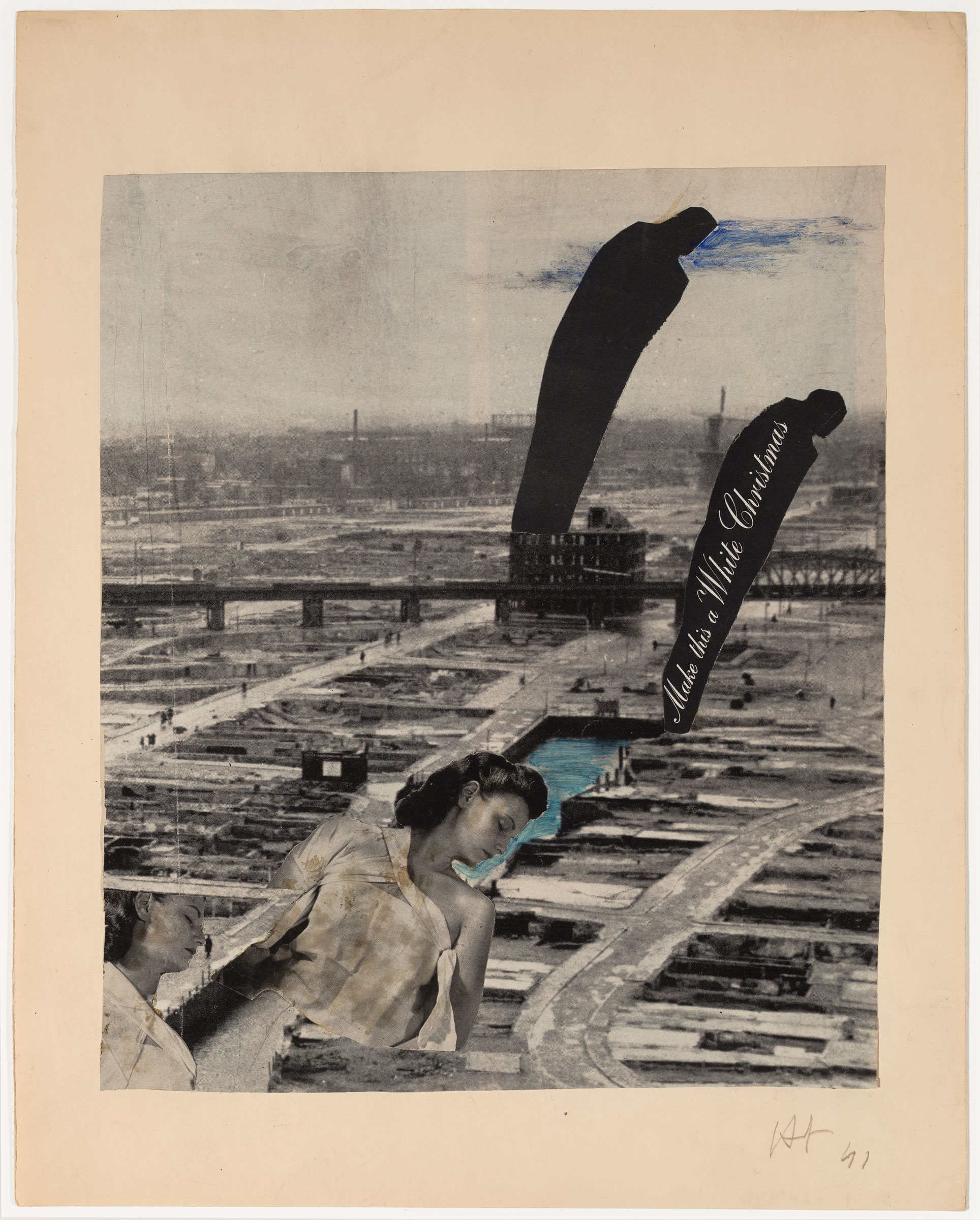
Chance Collage
Hedda Sterne used a surrealist automatist technique to create the collages she called papiers arrachés et interprètes. She would tear paper, let it fall, and then allow the chance-arranged abstract shapes to suggest forms that she developed with graphite.
Hedda Sterne, Composition surréaliste, c. 1938, collage and pencil on paper, 16.1 in. x 12.8 in. (41 cm x 32.4 cm), Collection of Centre Pompidou - Musée national d'art moderne - Centre de création industrielle, Paris (purchase, 2013)
Archival photograph of collage from Hedda Sterne's "Papiers Arrachés et Interprétés" series, c. 1938
Hedda Sterne, Untitled, 1940, Pencil and Japanese paper mounted on paper, 29 3/4 x 51 1/2 in.
Hedda Sterne, Katsonarock (Portrait of V.X.), 1941, Pencil and gouache on Japanese paper mounted on paper, 60 x 40 in.
Monotypes & Transfer Drawings
Hedda Sterne created a series of complex monotypes through experimentation with materials close at hand: oil paint, pencil, and paper. She applied layers of paint to a surface, placed paper on top, and drew with pencil on the paper to transfer lines of oil paint to the paper’s verso below.
Hedda Sterne, Untitled [Airplane cockpit], 1949, trace monotype, 15 7/16 × 10 3/8 in., Collection of the Whitney Museum of American Art, New York; Purchase, with funds from the Print Committee 2007.11
Hedda Sterne, Untitled, 1949, trace monotype, 19 x 13 1/4 in., Collection of Harvard University Art Museums; gift of the artist, 2005
Hedda Sterne, Untitled, 1949, Trace monotype, 14 1/4 x 10 1/4 in., Collection of Harvard Art Museums/Fogg Museum, Margaret Fisher Fund ([CDS Gallery, New York, New York], sold; to Harvard University Art Museums, December 15, 2005.), M26673
Hedda Sterne, Untitled (Vacuum Cleaner), 1949, Ink transfer drawing on paper, 11 5/8 in. x 14 3/4 in.; Collection of the National Gallery of Art; Gift, 2018
Hedda Sterne, Untitled, 1950, monotype, paint on paper, 12 1/2 in. x 8 1/4 in.; Private collection
Hedda Sterne, Untitled, 1950, transfer monotype, paint, graphite on paper, 14 1/2 in. x 11 5/8 in.; Collection of Des Moines Art Center, gift 2019
Hedda Sterne, Untitled, 1949, transfer monotype, paint, graphite on paper, 17 1/4 in. x 12 3/8 in.; Private collection
Poured Acrylic
Hedda Sterne was an early adopter of acrylic paint in the 1950s, but it was in the 1960s that she became interested in using the medium like watercolor, thinned and poured onto large, unprimed canvases. The technique carried with it a spontaneous, automatic quality that directed her to proceed, as she would say, “sans regret.”
Hedda Sterne, Metamorphosis, c. 1967, Acrylic on canvas, 72 × 54 in; Collection of the Whitney Museum of American Art, New York; Gift of Eric Green 69.113a‑b
Hedda Sterne, Cauliflower, 1967, Acrylic on canvas, 72 x 54 1/8 in.; Collection of the Smithsonian American Art Museum, Gift of Mrs. Madge Blumencranz, 1975.84
Rapidograph Technical Pen
Rapidograph technical pens were originally designed for use by engineers and architects who required precision lines in their drawings. Hedda Sterne used the thread-thin marks made by the pens to create complex automatic drawings, sometimes layering enough tiny lines to achieve areas of pitch black.
Hedda Sterne, Untitled, 1964, Rapidograph pen on paper, 11 in. x 6 7/8 in. (27.94 cm x 17.46 cm)
Hedda Sterne, Untitled, 1968, Rapidograph pen on paper, 14 1/2 x 11 1/2 inches (36.8 x 29.2 cm); Collection of Davis Museum at Wellesley College, Museum purchase, The Nancy Gray Sherrill, Class of 1954, Collection Acquisition Fund, 2019.1091
Hedda Sterne, Untitled, 1968, Ink on paper, 11 x 6 7/8 in., Collection of The Menil Collection, Houston
Hedda Sterne, Untitled, 1968, Ink on paper, 14 1/2 x 11 3/4 in., Collection of The Menil Collection, Houston
Hedda Sterne, Portrait of an American Indian, c. 1969, Rapidograph ink on paper, 14 1/2 x 11 1/2 in.